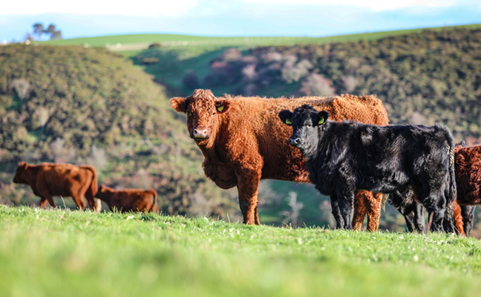
The use of Aberdeen-Angus as a terminal sire is delivering easier-fleshing cattle, better carcases, and award-winning beef for a Powys farming family
Farmers Guardian, 29th December 2025
The use of Aberdeen-Angus as a terminal sire is delivering easier-fleshing cattle, better carcases, and award-winning beef for a Powys farming family. A desire to produce easier-fleshing cattle which yield high-quality tasty beef led the Pugh family down the route of using Aberdeen-Angus as a terminal sire. Colin and Phyllis Pugh, in partnership with their son Gareth, run a mixed beef, sheep and arable enterprise at Cwmwhitton Farm, Knighton. The family farms 324 hectares (800 acres) of mainly owned land, where they run a herd of 125 Salers-cross cows. They also run a 900-ewe flock of Romneys crossed with Aberfield or EasyDam rams to produce fat lambs and grow 48ha (120 acres) of cereals to provide feed for the cattle and sheep. In addition, the family grows 28ha (70 acres) of seed potatoes and 3ha (7 acres) of ware potatoes, which are sold in bags directly from the farm.
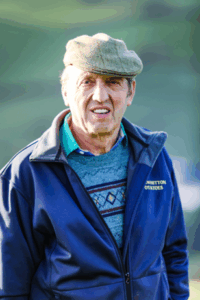
Like many commercial herds, the Pughs have introduced a native breed as a terminal sire in recent years.
Colin says: “We have had Salers since 1992, when we first started using them on Welsh Black cows, and we still use a Salers bull to breed our replacement heifers now.
“Traditionally, we were using Charolais or British Blue bulls on the rest of the herd, but we changed to Aberdeen-Angus five years ago.
“They work well on Salers cows producing easier-fleshing progeny of a more optimal carcase size which meet specifications and finish well and we like the fact they are polled too.”
Three bulls are run in the herd – one Salers and two Aberdeen-Angus.
“With the Aberdeen-Angus, we are looking for bulls with good length, a bit of size, and the ability to muscle up and give us better carcases. We are currently running two bulls from Middlesex breeder John O’Hara’s Glenade herd,” he says.
“As we are paid on a grid basis, the combination of Salers and Aberdeen-Angus genetics gives us frame and conformation – helping us to get the right grades.”
Outdoor calving
The Pughs run spring and autumn calving blocks, with the spring block starting in April, and the autumn block starting in September.
“Everything calves outside at grass and we aim to start the spring block after the clocks change at the end of March and be finished with the autumn block before the clocks change back at the end of October,” says Colin.
“The autumn-calvers are then housed, coming in around Christmas time, with their calves weaned in May, while the spring-born calves are weaned in November.”
Male calves are left entire and sold as bulls with the aim of getting them away before 16 months old at an average liveweight of 700kg and a deadweight of 400kg.
Heifers are sold fat at around two years old, at an average liveweight of 630-640kg achieving an average carcase weight of 320kg.
The bulls are fed home-grown wheat, barley, oats, and straw for finishing after weaning, while heifers spend time at grass after weaning, before being finished on a similar diet.
“We predominantly sell them to ABP in Shrewsbury or through the market fat,” says Colin.
“We also supply 26 heifers a year to our local butcher, GCSE Butchers in Presteigne.”
Award-winning beef
The introduction of Aberdeen-Angus genetics at Cwmwhitton Farm has not only helped the herd produce better carcases but also produced award-winning cuts of beef.
Colin says: “The Salers cross Aberdeen-Angus work really well for us. They are growing well on less feed than the continental crosses before, and we are getting a better fat class at the same weights as before.
“The butcher we supply gets tremendous feedback for the beef and he entered a rib of beef from one of our heifers at the 2024 Royal Welsh Winter Fair where it stood champion.”
Going forward, he says the family plans to continue using Aberdeen-Angus as a terminal sire and he hopes to reduce the finishing age of heifers.
“We’re really happy with the Aberdeen-Angus because our calves are getting a better finish with more fat and a nice quality carcase, as the champion Royal Welsh Winter Fair rib of beef shows.”
Farm facts: Cwmwhitton Farm
- 324ha (800 acres) of mainly owned land
- 125-cow Salers cross herd, crossed with Salers and Aberdeen-Angus bulls
- 900-ewe flock of Romneys crossed with Aberfield and EasyDam rams
- Bulls kept entire and sold at average of 400kg deadweight at 16months-old
- Both finished bulls and heifers sold direct to ABP Hereford or through the market, with 26 heifers sold to GCSE Butchers in Presteigne each year
- Rib of beef from a heifer supplied by the Pughs, and dressed by GCSE Butchers, was crowned champion at the 2024 Royal Welsh Winter Fair