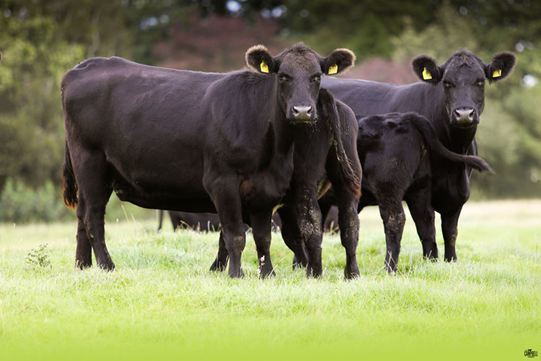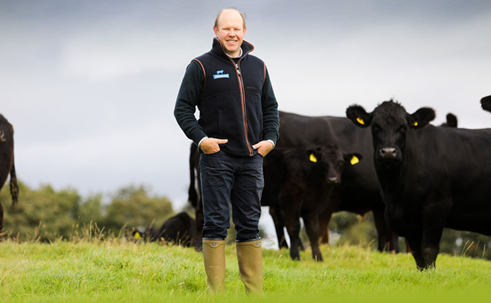
The Chapelton herd is synonymous with quality, well-bred native cattle as a result of the careful stockmanship of the Biggar family
Farmers Guardian 27 October 2025
Grange Farm is home to the Chapelton pedigree herds of Aberdeen-Angus and Beef Shorthorn cattle.
The 445-hectare (1,100-acre) farm, located near Castle Douglas, has been home to the Biggar family for almost 200 years and the current generation – brothers Jamie and Duncan, alongside their mother Emma – are determined to keep breeding high-quality cattle for years to come.
The farm has been home to Shorthorns since the 1940s, and Aberdeen-Angus genetics were introduced by Jamie and Duncan’s late father, Donald, following the foot-and-mouth disease outbreak in 2001.
Jamie says: “Our father started the Aberdeen-Angus herd at that point with the importation of a significant number of both Angus and Shorthorn embryos, primarily from North America.
“He could clearly see that the market was providing a premium for Angus-sired cattle, and he felt there was a great deal that the breed could bring to our breeding programme and also the UK national herd.”
Since then, numbers have grown and the Aberdeen-Angus herd stands at 75 cows, while the Shorthorn herd boasts 90 cows.
In addition, the Biggars run a 250-cow commercial suckler herd of Aberdeen-Angus and Shorthorn crosses.
Jamie says: “We’re a suckler cow business with the aim of producing an R4L carcase at 340kg at just under 600 days old.
“We aim to breed a functional, sustainable suckler cow which produces offspring that meet market specifications and provide a premium; and that is one of the reasons we are using both of these native breeds.”
He says the commercial cows are a mixture of Aberdeen-Angus and Shorthorn crosses using only genetics from the Chapelton pedigree herds.
Everything on the farm is home-bred, except for a few stock bulls purchased for the pedigree herds.
Bulls and breeding females from the pedigree herds are sold across the UK every year, and anything that is not kept as a replacement from both the commercial and pedigree herds is finished and sent direct for slaughter.
Jamie says: “All Aberdeen-Angus-sired cattle go for slaughter through Stoddart’s in Ayr or Dunbia Highland Meats for their premium Aberdeen-Angus schemes, and our Shorthorns tend to go to Woodheads for the Morrisons premium Shorthorn scheme.”
Breeding management
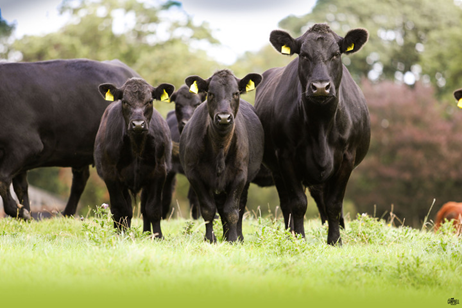
The Biggars run a tight eight-week spring calving period in March and April every year – something Jamie believes is made possible by the easy calving merits of the native breeds they work with.
He says: “We run a very condensed calving pattern, so it is a fairly busy time, but the breeds we work with mean it is a manageable challenge.
“We have problems like everyone else, but I think working with the breeds we have means those problems are minimised. We have cattle that want to get on with the job.”
The average age at first calving across all herds is 24.3 months old – a practice they have been running for almost 50 years.
Jamie says: “Over an eight-week bulling period, we are currently achieving a 90-91% pregnancy diagnosis rate, we are weaning 88% of the cows put to bull, and have an assistance rate of less than 7% in our commercial Aberdeen-Angus and Shorthorn cross cows.”
Nutrition management
Calves are weaned towards the end of October, after which point the older commercial cows are put on to an out-wintering system in big groups of 120-140 cows.
“They tend to start the winter for a month on bale grazing, then go for three months on winter forage,” says Jamie.
“This is something we have been working on quite closely with both SAC Consulting and Rhidian Jones of RJ Livestock Systems, to try new varieties, new mixtures and new systems.”
Jamie says the most recent out-wintered forage mix has been based on a hybrid mix of kale and hybrid brassica, alongside some swedes and turnips.
He says: “After being on the forage, the cows return to bale grazing and are calving in paddocks from the beginning of March. They are moved every day on fresh feed, rather than us taking the feed to them.”
He believes the system delivers multiple benefits, in that it is not only low-cost, but also a system the cows thrive on.
He says: “We are working in a fairly wet climate here, with an average rainfall of somewhere approaching 50 inches annually, but the cattle on the outside wintering system are very happy.
“The two breeds we are working with really lend themselves to this type of system, and we are trying to breed a cow which is moderate in size and easy fleshing, so she will go into winter carrying fairly significant fat reserves that will allow her to get through winter on minimal cost.”
Management
Despite its benefits, Jamie admits the overwintered system does not suit every animal on the farm and in-calf heifers and first calved heifers from the commercial herd are managed inside over winter.
He says: “This allows us to grow them on, manage their nutrition and not have young cows fighting older cows for the forage in those big groups.”
The pedigree herds are run outside until mid-December before being housed in slatted accommodation.
Rotational grazing is used in summer, and Jamie says a key aim of the family’s system is to produce a cow which will thrive on grass.
He says: “We are looking to put fairly moderate forage into a suckler cow and expect her to produce milk to feed her calf and sustain herself.
“This means we want to breed a cow which will thrive on 9ME [metabolisable energy] grass, rather than 12ME rocket fuel that you would need to put into a dairy cow.”
Once weaned, all calves are kept in sheds on a total mixed ration diet through winter before returning to grass for their second summer in April.
Jamie says: “We then look for a short, sharp finish at between 18-20 months old for our steers. To achieve this, we use a fairly intensive finishing programme for the last 60-90 days.”
Future plans
As the Biggars inch towards their third century farming at Chapelton, Jamie says they are hoping to continue making improvements across the board in their herds.
Jamie says: “My brother and I, and the team at Chapelton, were lucky enough to inherit a herd of cows which had a great deal of effort and work put into them from my father and those that went before us.
“We still have a lot of work to do. We are focusing on birth weight at the moment and there is more intervention in calving our heifers than we would like. We also want to chip away at our days to slaughter.
“If we can work away at the marginal gains, of even half a percent increase in our conception rate, or a handful of days knocked off our days to slaughter, all those things will work to make the business more sustainable and profitable going forward.”
He describes suckler cow production in the UK as an ‘exciting place to be’ at the moment – especially for native breeds, such as Aberdeen-Angus and Beef Shorthorn.
“For the first time in quite a while, the market is rewarding us for our efforts,” adds Jamie.
“If we can continue to breed cattle that are easy to manage, highly fertile, and produce a calf every year with minimal fuss, that then go on to hit market specification in a low-cost system – as delivered by native breeds – then there is no reason we cannot remain profitable going into the future.”