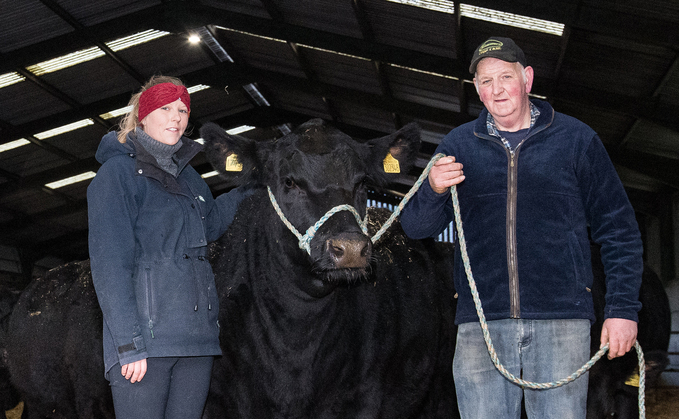
Pedigree cattle breeding is a passion for the Hodge family, who believe their mixed farming system is key to their business success.
The 110-cow Aberdeen-Angus herd at Rulesmains has enjoyed some considerable show success, and Andrew Hodge is a renowned breed judge. However, the 588-hectare (1,450-acre) unit near Duns in the Scottish Borders, also supports commercial sucklers and a small Hereford herd producing Black Baldy cross-breds. Meanwhile, a large acreage is dedicated to an arable rotation producing top-quality cereals.
The business operates a three-way partnership, with Andrew’s wife Jill overseeing the paperwork, while he is in charge of the arable rotation and helps his daughter Emma with the livestock. The family is assisted by Kerr Brown, who has been a team member for almost three decades.
While the Rulesmains Angus herd is Andrew’s pride and joy, Emma has established a small group of Hereford females under the RM prefix. In addition, the farm runs a commercial suckler herd of about 40 head, which produce Black Baldy cross-breds with a focus on spring calving.
Andrew says: “Surplus pedigree females are sold privately or through the breed sales each year, as well as about 30 breeding bulls.
“The commercial sucklers are descended from the dairy herd that was dispersed in 2007 and traditionally ran with the Angus. However, they now go to Emma’s Hereford sires because Black Baldy females are in great demand in the region.”
Black Baldy cattle
The Black Baldy is very popular in large numbers globally due to its numerous positive traits, he adds. These include docility, which reflects the temperaments of both the Angus and the Hereford. All the females are high health status, which is extremely important to customers.
The pedigree breeding policy uses embryo transfer from donor cows on occasion. Some will start calving in January, followed by the main pedigree group in February to April and the commercial herd in late spring/early summer. The latter group is turned out on to the grazing immediately post-calving.
“Once they reach nine or 10 years old, the very best Angus cows may be flushed for embryos,” says Andrew.
“I have no problem with using older genetics, because they contain some highly valuable qualities.
“A study of pedigree breeding will show that a female that has given outstanding performance will eventually produce progeny at a similar level, and possibly even better. The same policy does not apply to sires, because some of the modern bulls have a lot to offer.”
He has a clear picture of the ideal Angus bull and has sold to a top of £11,500 to date.
He says: “I prefer to view the dam in the flesh, if possible. Cow families are the building blocks of good cattle breeding. Over the years, the prominent cow families that have emerged are Princess Charlotte, Rosebud, and Lady Heather, to name but a few.
“The main criterion for female selection is based on her progeny achieving half her body weight by weaning at seven to eight months old. Otherwise, she will be down the road. Most of the cows will rear seven calves, and last year the calf survival rate was 98%, although that is not the case every year.”
Sire character and presence are paramount, according to Andrew.
“These two qualities are difficult to describe, but they have a strong positive influence on the herd in my opinion. Visual appearance is ranked above the figures, and plenty of length is also essential as it helps to pay the bills. In my experience, good length can add 50kg/head to the finishing weight, especially for a native breed,” he says.
“If an expensive stock bull is purchased, his semen will be harvested as an insurance policy and it may be used for the pedigree females. A 2024 purchase was Duncanziemere Mr Bulletproof at 20,000gns and his 2025 calves are looking very pleasing. Artificial insemination bulls also feature in the breeding programme.”
Rewarding pastime
Showing and judging Aberdeen-Angus cattle is a rewarding pastime for Andrew, as well as providing a shop window for the Rulesmains herd, and he will be judging the Angus lines at the Stirling Bull Sales this February.
He says: “The Royal Highland and the Great Yorkshire are the two main shows, and in 2025 Rulesmains produced the Royal Highland male champion and the junior champion, as well as taking reserve in the beef section. Nevertheless, the overall beef breed championship at the Highland has eluded me so far, although my father achieved it in the dairy classes with an Ayrshire. It is one of my top ambitions for the future.”
Like her father, Emma has been ‘bitten by the showing bug,’ and is in demand as a judge on the Hereford show circuit, as well as leading the show teams. Despite only having registered her first RM Hereford in 2021, she has already picked up a number of first prize wins, including the cow class at the Scottish National Hereford Show, the Royal Highland junior award in the breed section and the overall championship at the National Poll Hereford event in England.
Nutrition
A forage-based ration sustains the cattle throughout the winter, when they are housed on straw from the end of October.
“I am a firm believer in forage for ruminants, as that is what nature intended,” says Andrew.
“It applies to the show team, and even the finishing cattle will receive half of their nutrition from forage. The cows are maintained over winter on silage, straw and minerals. The only exception is the six weeks before calving, when they might be given 1kg/head of farm-saved barley or soya to boost colostrum production.”
Youngstock that are not required for breeding are finished on-site, with the bulls fully housed and left entire. They are sold at 14 months at an average 400kg deadweight and with at least half the batch achieving U-grades. A mixed calf group has recently been recorded with a daily liveweight gain of 1.75kg from birth to weaning. This figure can only be attained by limiting sire selection to bulls with a plus score for milk, adds Andrew.
Arable cropping
He says: “I estimate that generous farmyard manure application can lift first wheat yields by up to 0.5 tonnes/acre on the mainly plough-based system. The lowland unit, which has a soil type ranging from sandy to heavy loam, grows wheat, malting barley and oats, with a 10t/ha first wheat yield average. All operations are carried out in-house and we offer a local contracting service for silage and straw baling.
“Soil health is paramount for getting the best crop results. The FYM improves soil structure and microbiology. It also helps with moisture retention in a dry season, and that was vital last year when wheat yields were very good.”
The barley is grown on contract for a whisky distillery and the oats go to Morning Foods, where they are used for making muesli bars and similar products. Vining peas for human consumption and oilseed rape are sown as breaks.
Andrew’s interest in cattle breeding was sparked when the farm had a dairy unit. He is also a master ploughman and ploughing competition judge, having won the reversible section in the 1987 Scottish Ploughing Championships.
“My father Thomas came to Rulesmains in 1968 and we milked a mixed breed herd,” he says.
“The Ayrshires and Holsteins were shown extensively and I enjoyed preparing and exhibiting the cattle. After the dairy cattle were sold, the commercial sucklers were brought in to utilise the permanent pasture, but within a year I had purchased a few Angus cattle with Rawburn and Blelack bloodlines. The pedigree enterprise started as a hobby, but I have to admit that it quickly got out of hand.
“The arable rotation complements the livestock enterprises, not only improving cereal yields but also increasing business security. The old saying ‘up horn, down corn’ is just as relevant in today’s farming climate.”
Farm Facts
- Lowland beef and arable unit – 588 hectares (1,450 acres)
- Pedigree Aberdeen-Angus and Hereford herds
- Commercial herd producing Black Baldy cross-breds
- Beef finishing enterprise
- Forage-based livestock system
- Arable rotation: Wheat, spring barley, oats
- Oilseed rape and vining peas as break crops
- Cattle show wins include tickets at the Royal Highland