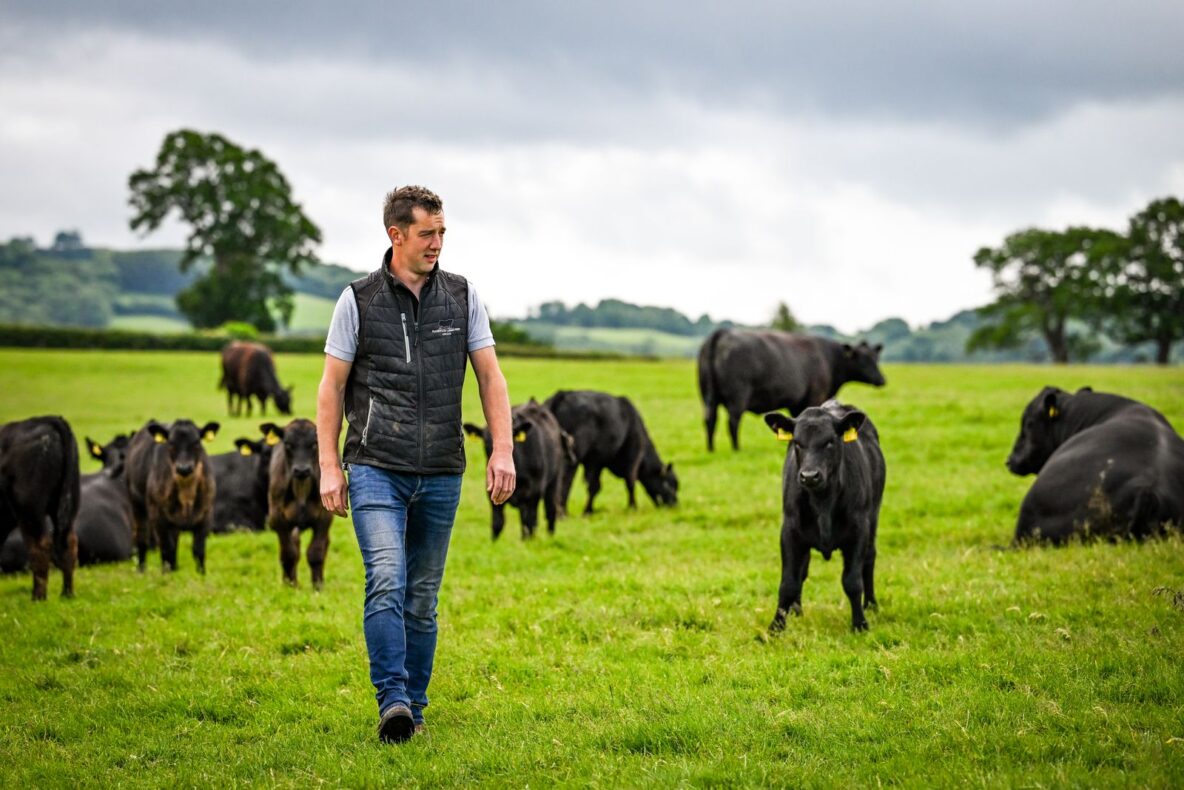
For the Gilbert family, the decision to switch from continental cattle to Aberdeen-Angus wasn’t driven by pedigree ambitions but a desire to build a more resilient and profitable suckler beef system. Yet eight years in, demand for both breeding bulls and females is rapidly growing, with plans to further expand the herd.
Brothers Harry and George Gilbert farm in partnership with their father Nick and uncle Phil, at Harewood Farm, a mixed livestock and arable enterprise on the Welsh-English border near Hay-on-Wye.
While George oversees the sheep enterprise, Harry manages the cattle where a focus on efficiency, simplicity and low-input production has transformed the suckler herd.
The 700-acre farm comprises 400 acres of grassland and 300 acres of arable cropping, growing wheat, barley, peas and oats. Alongside 1,200 sheep, the business runs 80 pedigree Aberdeen-Angus cows under the Harewood prefix.
Across both the sheep and cattle enterprises, the family has adopted a clear philosophy – reduce inputs, keep costs under control and build systems that are less exposed to external costs.
“We’re trying to create a less intensive farming system that is as simple and efficient as possible,” Harry says.
“The less reliant you are on purchased inputs and additional labour, the more resilient your business becomes and there’s greater scope to improve profitability.”
That mindset ultimately led them to Aberdeen-Angus cattle, a move that they have not regretted.
Time for change
The family’s journey with the breed began in 2018 during a search for high-health-status replacement females.
While initially looking for suitable heifers, Harry became increasingly interested in Aberdeen-Angus due to the breed’s ability to thrive in lower-input systems.
Purchasing foundation females from the Rosemead and Dark Lane herds, the family established what has since become a successful pedigree herd supplying breeding stock to commercial beef farmers, dairy producers, as well as other pedigree breeders. Today, repeat customers account for a growing proportion of sales.
“We weren’t looking for cattle that were going to top the show ring necessarily,” explains Harry.
“We were looking for an animal that would be profitable within our system, which is very much run on a commercial basis.”
The herd is now largely self-replacing, with all replacement females bred on farm and home-bred bulls also used as herd sires. New genetics are introduced primarily through AI, alongside carefully selected bulls from other breeders.
Among those making a significant impact are Harewood Jet, a four-year-old home-bred bull by Rawburn Boss Hogg, and McCornick Ecosse, which was purchased from Stirling bull sales in 2025 after being identified as a bull capable of breeding the moderate, functional cattle the farm values.
Commercial traits come first
While Harewood operates as a pedigree herd, Harry is clear that commercial functionality drives every breeding decision.
Moderate-framed cows weighing around 750kg in peak condition in the summer are the target. Feet, legs, udder and temperament are non-negotiables.
Likewise, bulls need to be well balanced, easy fleshing and capable of thriving in commercial environments.
“We’re not trying to breed extremes,” says Harry. “Were looking for that balance of muscle, growth and fleshing ability.
“While the cows weigh heavier than you’d expect because they flesh so well, they are not big-framed cows and are considerably smaller than in our previous herd.”
That philosophy extends to herd management, where a strict culling policy ensures only the most functional animals remain.
“If they have poor feet, poor udders, bad temperament or anything that makes them harder to manage, they’re gone.”
Lower labour
Perhaps one of biggest changes the family has noticed since moving to Aberdeen-Angus is the reduction in labour required to manage the herd.
The previous continental herd demanded significantly more intervention, particularly around calving time. Today, the system largely runs itself.
“The cows calve themselves, the calves are up and sucking quickly and I don’t need to dehorn anything, it’s incredibly different to what we were used to before,” he says.
“All those little jobs add up. When you take them away, it makes a huge difference.”
Those efficiencies are particularly important given the division of responsibilities within the business, allowing Harry to manage the cattle enterprise largely independently while George focuses on the sheep flock.
The financial benefits are equally compelling, compared with the previous suckler herd and winter feed requirements have fallen substantially.
Harry estimates the Aberdeen-Angus cows save approximately £100 per head in silage costs alone over the housing period.
“The reduction in feed costs is simply down to the fact we don’t need to feed the cows as much and can include more straw in the ration.
“For a suckler beef producer that reduction in cow costs has a significant impact on overall profitability.”
Finishing performance
Although over 50 percent of cattle are sold as breeding stock, the lower-end are finished on-farm and sold to ABP.
Again, the economics have reinforced the family’s confidence in the breed.
“While continental cattle previously required close to 12kg of concentrates per head per day to finish, the Aberdeen-Angus cattle are finishing on half of that,” says Harry.
Importantly, they are still reaching similar finishing weights and market requirements.
“We’re putting far less feed into them but still getting the result you need; bulls are still going at 16 months old at 380-400kg deadweight.”
High health driving demand
Alongside functionality and efficiency, health status has become another cornerstone of the Harewood breeding programme.
The herd is accredited Johne’s Risk Level 1, BVD-free, IBR-accredited and Neospora-accredited, providing confidence for customers purchasing breeding stock.
Harry believes this gives them a good market advantage.
“It’s something buyers are asking about more and more,” he says. “People want to know the cattle they’re bringing onto their farms are coming from a herd with strong health credentials.”
Combined with the opportunity for customers to see the cattle performing in a genuine commercial environment, this has helped grow their customer base and they are now regularly seeing repeat business.
Built for the future
Looking ahead, Harry plans to expand cow numbers from 80 to 100 head, supported by growing demand and confidence in the breed.
“I think Aberdeen-Angus genetics offers exactly what modern beef production needs” he says.
“They’re lower input cattle with strong market demand. If you’re less reliant on feed, labour and other costs you can’t control, you’re in a much stronger position as a business.”