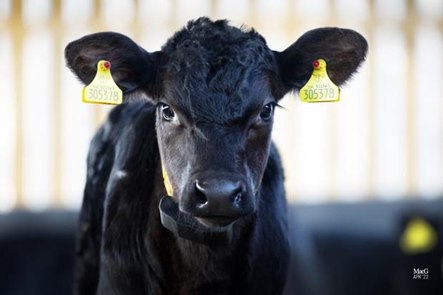
Aberdeen Angus a viable option for maximising calf value
By Peter Harrison, The Scottish Farmer, 13th September 2025.
Retained females can also provide the basis for a suckler herd
Over the past decade, dairy enterprises have increasingly strived to maximise the economic potential of every calf born, not merely milk yield. With the shift towards beef and dairy production systems, Aberdeen-Angus genetics have become central to optimising both reproductive efficiency and beef output.
According to the Aberdeen-Angus Society, the breed offers a combination of moderate birth weight, short gestation, robust neonatal vigour, and consistent growth trajectories, making it particularly suitable for integration into dairy herds aiming to produce high-value calves for breeding cattle, finishing systems or premium beef supply chains.
The Society states: “The Aberdeen-Angus can be seven to 10 days shorter gestation length than some other continental breeds, with farmers reporting that Aberdeen-Angus cross dairy calves have a higher survivability rate also. The growth weights are attractive once the calves are on the ground, and beyond the farm gate there is an attractive premium for dairy-bred cattle providing they are of good quality and sired by a registered bull.”
Pedigree breeders have for some time been utilising these genetic traits within their herds, which passed down the chain into the dairy industry is producing both efficiently finished beef cattle as well as commercial breeding females fit to bull with a terminal sire to produce suckled calves or store and prime cattle. One such breeder is Andrew Elliot, of the Blackhaugh Herd in the Borders, who stated: “I think the Aberdeen Angus is the perfect bull for the dairy industry. Using polled bulls with easy calving figures and a short gestation length, means dairy cows can enter the parlour quicker and return to service more quickly also. This combined with selling beef under the Aberdeen Angus brand, makes a compelling argument for the use of Angus within the dairy herd. In breeding pure Aberdeen-Angus we look for thick and well-balanced cattle with good locomotion, and for what I call the profit traits of fertility, calving ease, milk and good growth rates.”
National registration data also indicates a clear trend, with AHDB reporting that while Holstein bulls have historically dominated dairy herds, the proportion of calves sired by beef bulls, including Angus, has steadily increased. Figures collected between April 2024 and March 2025 indicated a 53% use of beef semen. The British Blue is still the most popular beef sire, at 42%, due to the popularity of the British Blue cross calves within the auction marts, but Aberdeen-Angus is not far behind at 38%.
Aberdeen Angus cross-calves offer premiums to the dairy farmer
Calving ease
Calving ease remains a critical parameter for herd management, influencing perinatal mortality, cow health, and post-partum fertility. Aberdeen Angus sires consistently produce calves with moderate birth weights (typically 36-40kg) and short gestation lengths (approximately 274-277days), which reduces difficult births typically caused by an awkwardly positioned foetus relative to continental beef breeds.
One such farmer, who in the past decade has switched from continental to Aberdeen-Angus sires, is John Harrison who farms 300 New-Zealand Friesians on a block-calving and grass-based system at Silloth, north-west Cumbria. “Calves were too heavy resulting in difficult calvings,” explained John, “but the Aberdeen-Angus, produces lighter calves with fantastic calf vigour, they’re desperate to get up and going. The improved calving is also helping to tighten up the calving pattern.”
Estimated breeding values attached to registered bulls as a requirement for the Aberdeen-Angus breedplan, records calving ease as well as birth weight and gestation length. The adoption of high EBV sires further optimises outcomes, with trials between AHDB and Harper Adams illustrating these performance percentiles, with top 10% bulls achieving a gestation length of 274 days with a calving score of 1.8.
Neonatal vigour and feed conversion
Beyond calving, neonatal vigour and early post-natal growth are decisive factors in determining lifetime performance. Angus calves display high vitality at birth, with strong suckling behaviour and low morbidity. Herdsperson’s from various farms report that the Angus-calves are ‘easier to teach to drink and are far livelier and more eager to feed than other continental sired calves’, which potentially demonstrates a higher-feed conversion rate. Through the use of EBV’s within registered bulls, growth trajectories are predictable, particularly when sired by top 10-25% bulls, which in turn helps budgeting and profitability.
Feed-conversion rates within the breed are demonstrated by Oxfordshire farmer Andrew Farrant, who milks 600 cows of a mix between Norwegian Red, New Zealand Friesian and Holsteins, on a predominantly grass-based system. Using the Aberdeen-Angus bull, 650-700 dairy cross calves are finished each year, with Andrew’s cousin Ian, who runs the dairy beef unit reporting that: “We had enjoyed using British Blue genetics for many years, but we were struggling to finish the cattle without the need for a lot of concentrates. When they got to 16-months-old we could finish them on a ration, but we ended up having to throw vast amounts of concentrates at them which just wasn’t sustainable. The Aberdeen-Angus crosses spend 30-60 days on a finishing ration and they’re achieving an average daily liveweight gain (DLWG) of 1.5-1.8kg, based on a grass and maize silage-based diet, with about 4kg of cereals a day.”
This was compared to the British Blue crosses, which spent 60-90 days on the finishing ration and achieved an average DLWG of 1.4kg. “The weight gain was fine, but the problem was the length of time they were spending on the finishing diet. Since moving to Aberdeen-Angus we’re using far less cereals, estimating we only need a third of the amount to finish the Angus cattle compared to the Blues.”
This feed-conversion is also a factor for lower input systems like John Harrison’s, who sells Angus-cross stores at 18-months with little concentrate feed. A month after calving the calves are put out to grass at one-month old, illustrating the hardiness of the Aberdeen-Angus combined with the New Zealand Friesian genetics. “They thrive on grass”, said John, who introduces a barley and soya mix at six months old. “These calves are then outwintered on kale and round bale straw, on land that is free draining soil. They perform well on good quality grass in their second summer, before heading to the store ring”.
Within a finishing system like the Farrants, carcass weights from Angus-crosses recorded at 315-320kg at grades ranging from a mid R to an O+. Although this is slightly lighter than British Blues, which had previously averaged carcase weights of 330-335kg, at typically half a grade higher than the Angus crosses, the business recorded being happier with the end result and not interested in pushing for heavier cattle.
Ian adds: “I’d rather have a higher throughput and sell them slightly lighter, because there’s huge potential to lose money in the finishing shed, especially with heavy cattle.”
The AHDB trial also illustrates the use of EBV recorded bulls which produce a uniform carcass performance as facilitating planning towards a batch slaughter, as well as illustrating the aforementioned feed conversion optimisation.
Breeding females
The Angus-cross can also produce an efficient breeding female, which crossed with a terminal sire such as the Charolais can produce a suckled calf with high commercial value.
Scottish farmers in particular favour the black-hided female in the form of the Aberdeen-Angus cross cow to produce the white or orange coloured calve that is favoured by buyers when sold as suckled calves.
Combining such a terminal sire over the Aberdeen Angus cross has created a stratified system within the dairy to beef herd, capitalising on current market conditions with a distinct lack of supply leading to healthy returns across the sector. The Angus-cross also presents opportunities for the new entrant, when sold as bucket reared calves to eventually bull. Although a timely process, the eventual female bought for between £400-£650 dependant on the age and quality could provide the basis of which many farmers could build a profitable beef suckler herd around, if capital is not readily available to buy-in mature beef females.
The Aberdeen-Angus can also provide the basis for large scale producers operating a low-cost system focussed around out-wintered cattle. One such producer is James Nisbet, of Sorn Mains, Ayrshire, who calves 450 Aberdeen Angus cross cows each year, predominantly bulled by the Charolais. Outwintered cows are brought in for calving and head back to rough ground as soon as they have calved, with calves getting warm coats to protect them against the elements for the first three weeks before being brought back to de-horn and castrate and put straight back to the hill. “You really cannot beat the Charolais calf in the store ring – there is a real demand for the orange and white calves,” said James, who sells the majority of his calves through Stirling, with some going to Lanark and Ayr.